Mudik: The Longing to Return to the Origin
3/16/20264 min read
Mudik is not merely the return of bodies to hometowns, but the remembeing of origins. Roads fill with travelers, yet the deeper movement is inward. Beneath reunions and familiar doors lies a quiet truth: every journey home echoes a greater return—the human soul’s longing to find again the first beginning from which life once unfolded.
When the journey back to family becomes a reflection of the deeper return to the Origin
Standfirst
Mudik is more than a journey back to one’s hometown. Beneath family reunions and the embrace of parents lies a deeper symbol: the human longing to return to the origin of life.
Epigraph
When a person returns to their parents, they may be remembering—without realizing it—the path back to the origin of life.
“Listen to the reed flute, how it tells a tale of longing; ever since it was cut from the reed bed, it cries for its return.”
— Jalaluddin Rumi
The Journey Home
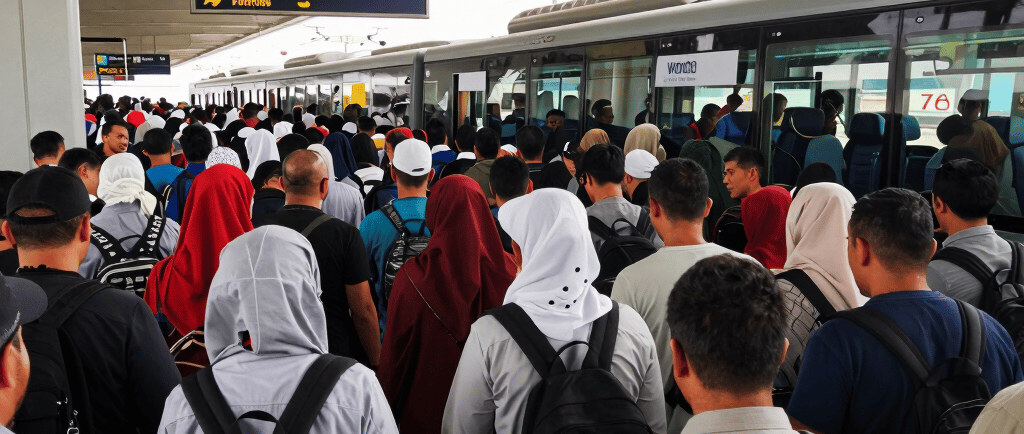
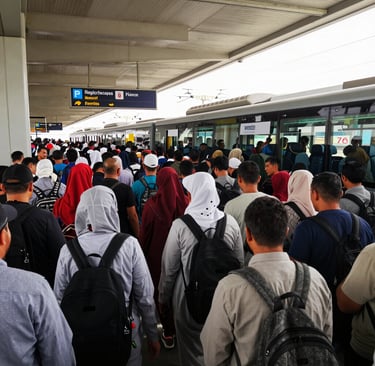
Every year before Eid al-Fitr, millions of people across Indonesia begin moving in the same direction: home. Highways fill with traffic, train stations overflow, and airports become crowded with travelers.
Yet beneath this great collective movement lies something deeper than a holiday journey. There is a longing older than the journey itself—the human desire to return to its origin.
Ramadan prepares the heart for this inward journey. Fasting cultivates simplicity, patience, and awareness that life is not only about the visible world, but also about our relationship with God and with one another.
The Two Ropes of Life
The Qur’an speaks of two bonds that sustain human life.
“Hold fast, all together, to the rope of God and do not be divided.” (Qur’an 3:103)
Another verse adds an intriguing dimension:
“Humiliation was imposed upon them wherever they were found, except when they held fast to a rope from God and a rope from people.” (Qur’an 3:112)
Here the Qur’an speaks of two ropes of life:
ḥablun min Allāh and ḥablun mina al-nās.
The first is the vertical bond—faith, prayer, and orientation toward God.
The second is the horizontal bond—solidarity, compassion, and responsibility toward fellow human beings.
Human life cannot remain whole without both.
Silaturahmi and Mercy
For this reason Ramadan concludes with silaturahmi—the renewal of relationships.
People visit relatives, greet neighbors, and mend relationships that may have grown distant. In Islamic tradition this is not merely a social custom, but part of the expansion of raḥmah, the mercy that binds humanity together.
Yet modern life presents a paradox: our social networks grow wider, but the circle of our compassion often becomes smaller.
Mother Teresa once warned that one of the illnesses of modern society is our tendency to define the circle of our brothers and sisters too narrowly.
True spirituality, however, always moves in the opposite direction—it expands the circle of compassion.
Mudik and the Memory of Home
In Indonesia, this widening circle of affection finds a unique cultural expression in the tradition of mudik.
Millions leave the great cities and travel back to their hometowns.
Socially, mudik is a homecoming. Yet symbolically it carries a deeper meaning: the human longing to return to the origin of life.
For many people, the home of their parents is the first bayt they remember—the place where they first encountered love, language, and the rhythms of life.
The Soul’s Memory of Return
The Qur’an expresses this cosmic movement in a simple yet profound sentence:
“Indeed we belong to God, and to Him we return.”
In Islamic metaphysics this movement is often described as rujū‘, the return.
For the great mystic Ibn Arabi, the entire universe unfolds within a divine cycle: all things originate from God and ultimately return to Him.
Meanwhile, the philosopher Mulla Sadra describes existence itself as a dynamic journey of becoming—a continuous movement toward perfection and toward its ultimate origin.
Seen from this perspective, the journey of mudik appears as a small earthly symbol of this larger metaphysical return.
The Reed Flute
In the famous opening verses of the Masnavi, Jalaluddin Rumi writes about the reed flute that laments its separation from the reed bed.
Its music is the sound of longing.
A friend once told me—an economist and statistician trained in the language of numbers—that he sometimes finds himself in tears while reading Rumi’s poetry.
Perhaps such poetry touches something older than the intellect: the soul’s memory of its origin.
The Deeper Meaning of Homecoming
Perhaps this is why journeys home feel so powerful.
Behind the crowded highways and busy train stations, human beings are responding to an ancient memory within the soul.
Meeting one’s parents during Eid often feels like more than a family visit. It is as if we briefly touch the roots of our own existence.
Silaturahmi preserves the rope of humanity.
Worship preserves the rope of God.
And in the journey of mudik, these two ropes seem to meet: returning to family while remembering the deeper return to the Origin.
Closing Reflection
If all existence comes from a single source, then every human journey ultimately becomes a movement of return.
Perhaps this is why the longing for home never fully disappears from the human heart. Deep within, the soul still remembers where it came from.
Each step toward our parents’ home on Eid reminds us of a greater truth: life is not only a journey outward into the world, but also a journey back.
And as the Qur’an reminds us, all journeys eventually converge in a single direction—the return to God.
Signature Line
Perhaps all of life is a long journey of learning how to find the way home.