The Letter That Contains an Ocean: The Mystery of Nūn in the Qur’an
3/9/20263 min read

ن ۚ وَالْقَلَمِ وَمَا يَسْطُرُونَ
Nūn. By the Pen and what they inscribe. (Qur’an 68:1)
A single letter in the Qur’an—Nūn—may contain one of the deepest symbols of descent, darkness, and renewal ever preserved in sacred language.
Opening
Nūn.
A single letter—yet an ocean of meaning.
A curve, a dot—almost a sound. From this solitary sign unfolds an entire universe of symbols: descent into darkness, the preservation of life, and the quiet promise of renewal.
In the story of Jonah, darkness becomes a place of awakening. In the story of Noah, the flood becomes the cradle of a new world.
Both narratives echo the same mystery: before renewal, there is immersion; before dawn, a long night.
The letter Nūn seems to hold this secret in its form—a curved vessel containing a silent center, a world suspended between dissolution and rebirth.
Nūn and the Story of Jonah
Within Islamic tradition, the letter Nūn is closely associated with the story of the Prophet Jonah, who is called in the Qur’an Dhū al-Nūn—“the one of the fish.”
Cast into the depths of the sea and swallowed by a great fish, Jonah found himself surrounded by layers of darkness: the darkness of the night, the darkness of the sea, and the darkness within the creature itself.
Yet in that depth he uttered a prayer that became one of the most powerful invocations in the Qur’an:
“There is no god but You. Glory be to You. Indeed, I was among the wrongdoers.” (Qur’an 21:87)
What appears outwardly as punishment reveals itself inwardly as transformation. The belly of the fish becomes a hidden sanctuary where the ego dissolves and a deeper awareness awakens.
Emerging from that darkness, Jonah begins again.
Nūn at the Center of the Alphabet
In the Arabic alphabet of twenty-eight letters, Nūn occupies the fourteenth position, precisely at the center.
Symbolically, this central position suggests a world in transition—suspended between origin and completion, between descent and return.
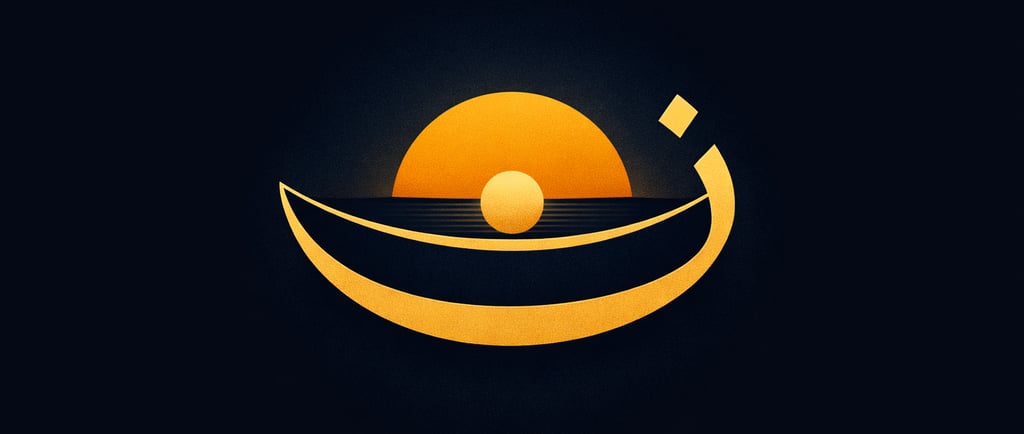
The shape of the letter reinforces this symbolism. Written as a curved line with a single dot above it, Nūn resembles a vessel that holds something precious within.
The curve suggests containment, like an ark floating upon waters. The dot at its center evokes a point of stillness—a hidden axis around which movement unfolds.
In this sense, the letter Nūn becomes a visual metaphor for existence itself: a world in motion, yet anchored by an invisible center.
The Ark of Noah
The curved form of Nūn naturally recalls another great narrative of preservation: the Ark of Noah.
In the Qur’anic story, the flood overwhelms the world, sweeping away the structures of the old order. Yet within the ark, the seeds of life are preserved.
The ark is not merely a vessel of survival; it is the bridge between two worlds.
Seen symbolically, the curve of Nūn resembles such a vessel—carrying within it a point of life that endures even when the surrounding world collapses.
The dot at its center becomes the seed that survives the flood.
A Symbol Beyond One Tradition
The symbolism embodied in Nūn is not confined to Islamic thought. Across civilizations, similar patterns appear.
In Hindu tradition, the Matsya avatar—the divine fish—guides humanity through a cosmic flood and preserves the sacred knowledge of the world.
In early Christianity, the Ichthus, or fish symbol, becomes a sign of salvation and new life.
Though these traditions differ in theology and narrative, they echo a shared intuition: life often passes through water, darkness, and dissolution before renewal can emerge.
The Mystery of Descent
The letter Nūn quietly teaches that descent is often the beginning of transformation.
Jonah’s descent into the sea became the threshold of awakening. Noah’s passage through the flood carried the promise of a new creation.
Both stories reveal the same paradox: what appears as an ending may in fact conceal a beginning.
The curved form of Nūn seems to capture this moment of suspension—when the world is neither what it was nor yet what it will become.
A Letter That Invites Reflection
Seen in this light, Nūn is far more than a sound in an alphabet.
It is a symbol of passage—a reminder that existence itself unfolds through cycles of descent and renewal.
Within its quiet curve and solitary point lies a subtle wisdom: even in darkness, life preserves its center.
And perhaps this is the secret whispered by the letter Nūn:
every ending carries within it the seed of a beginning.
Reference: René Guénon, The Mysteries of the Letter Nūn, Studies in Comparative Religion Vol. 14, Nos. 1–2 (Winter–Spring, 1980).