The Price of Power: War and the Erosion of Humanity
4/8/20262 min read
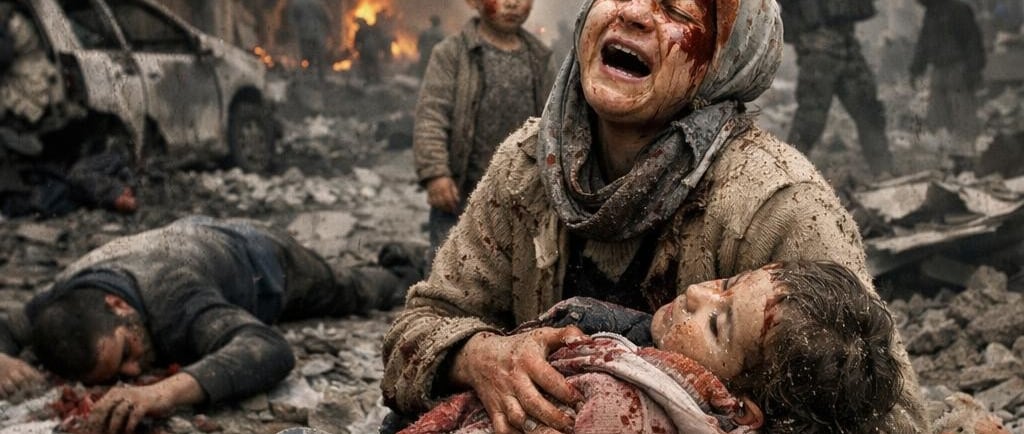
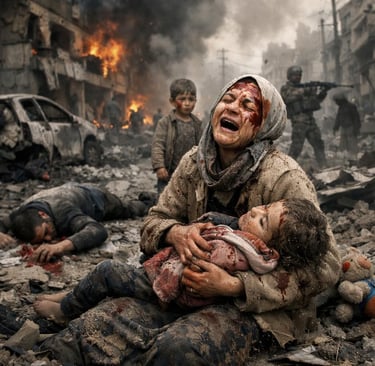
We often measure war in territory gained and enemies defeated.
But what if the real cost of war is not land, nor power—
but the slow erosion of what makes us human?
Power promises control. War enforces it.
Yet beneath the noise of strategy and victory, something quieter is lost—
empathy, dignity, and the fragile thread that binds us to one another.
Let us be honest for a moment.
What is unfolding today
is not merely a war.
It is power asserting itself—
in the language of security.
States speak of stability,
of threats,
of the right to defend.
Yet beneath these words,
something far more real persists:
people.
Not abstractions—
but families,
children,
lives interrupted without consent.
Before strategy, before geopolitics,
there are those who do not choose this war—
yet bear its full weight.
Homes collapse in seconds.
Names turn into numbers.
Grief becomes routine.
No doctrine of security can explain this.
No justification can carry its weight.
This is not collateral.
This is the center.
And yet, power continues to speak
as if suffering were secondary.
What we are witnessing
is not only a clash of military force,
but a deeper failure:
the separation of power from ethics.
Technology advances.
Precision increases.
But the moral distance widens.
Fear, in this landscape,
is not incidental.
It is produced,
amplified,
and mobilized—
to justify actions
that would otherwise be indefensible.
The Qur’an once articulated a possibility
that now feels painfully familiar:
“…a being that will spread corruption and shed blood…”
(QS 2:30)
Not as condemnation,
but as warning.
That human beings,
when unrestrained by higher guidance,
can normalize destruction
while believing themselves justified.
This is why the problem is not simply
who is right or wrong.
It is whether power
still recognizes its limits.
Because once it does not,
violence no longer ends—
it circulates.
From one hand to another.
From one generation to the next.
What, then, can interrupt this cycle?
Not more force.
Not better narratives.
But a return to a higher moral reference—
a norm from above—
that does not bend
to fear or interest.
Without it,
peace is only a pause between wars.
The Qur’an states a law
beyond negotiation:
“If you do good, you do good for yourselves;
and if you do evil, it is against yourselves.”
(QS Al-Isra: 7)
What is done to others
does not disappear.
It returns—
sometimes magnified.
This is not only about one region.
It is about the kind of world
we are becoming:
a world that refines its weapons,
but neglects its conscience.
And perhaps the most dangerous shift
is this:
we are getting used to it.
Destruction no longer shocks.
Suffering no longer interrupts.
And when that happens,
the loss is no longer only out there—
it is within us.
So this is where we stand.
Not merely as observers,
but as moral participants.
The question is not only
what side we are on—
but whether we are still able
to see the human being
at the center of it all.
In the end,
civilizations do not collapse
from lack of power.
They collapse
when power no longer remembers
what it is for.